
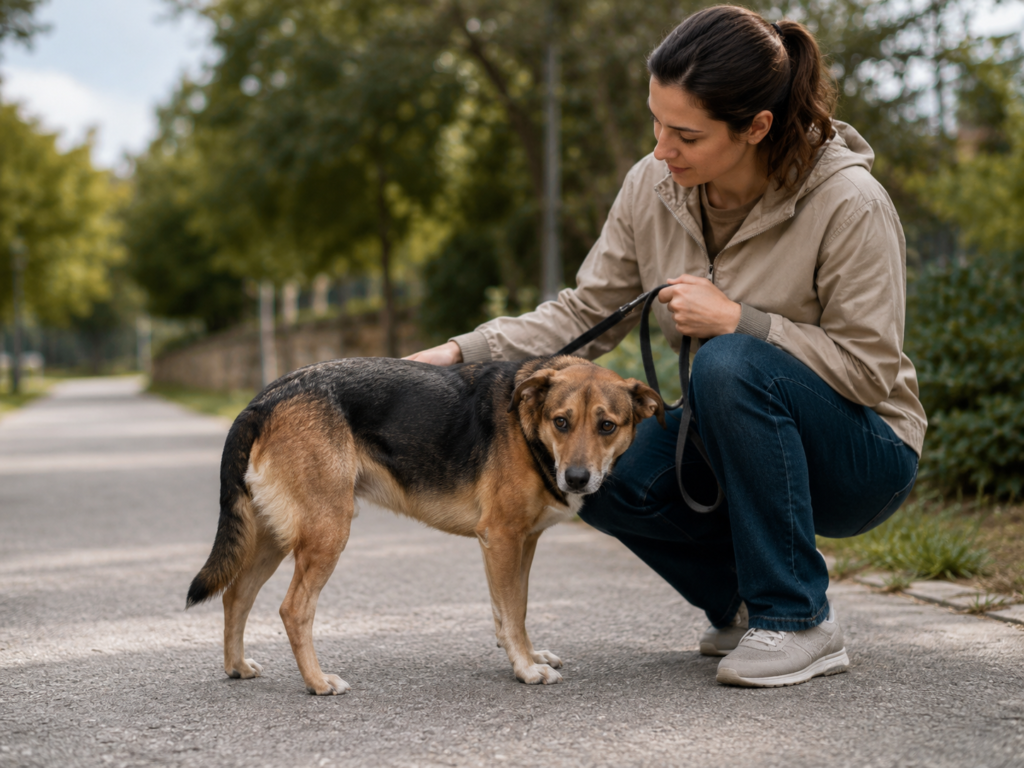
A dog’s tail can reveal valuable information about how they are feeling. When a dog suddenly holds their tail lower than usual, tucks it between their legs, or stops wagging completely, they may be communicating fear, uncertainty, stress, or physical discomfort.
However, a lowered tail does not always mean something is wrong. Some dogs naturally carry their tails close to the ground, while others have tails that curl over their backs. The most important question is whether your dog’s tail position has changed from what is normal for them.
Understanding the difference between a relaxed low tail, a tightly tucked tail, and a physically limp tail can help you decide whether your dog needs space, behavioral support, or veterinary care.
Is a Low Tail Always a Problem?
Not necessarily! Every dog has a natural or neutral tail position. Breed, body structure, emotional state, and the surrounding situation all influence how the tail is carried.
For example, some dogs naturally hold their tails low when relaxed, while breeds with curled tails may normally carry them high over their backs. A tail position that looks unusual in one dog may be completely normal in another.
Instead of comparing your dog with other dogs, compare their current posture with their usual behavior.
Pay closer attention when:
- The tail is suddenly lower than normal
- The tail is tightly tucked against the abdomen
- Your dog cannot lift or wag the tail
- The tail appears painful when touched
- The position is accompanied by other behavioral or physical changes
A tail should never be interpreted by itself. Facial expression, ears, posture, movement, breathing, and the surrounding environment provide essential context.
Low, Tucked, or Limp: What Is the Difference?
Although these positions may look similar, they can communicate different things.
A Lowered Tail
A lowered tail is positioned below the dog’s normal resting level but is not pressed tightly against the body.
This can suggest:
- Mild concern
- Uncertainty
- Social hesitation
- Stress
- An attempt to avoid conflict
The dog may still move or gently wag the tail while deciding how to respond to the situation.
A Tucked Tail
A tucked tail is pulled closely underneath the body or between the back legs.
This commonly appears when a dog feels:
- Frightened
- Threatened
- Overwhelmed
- Socially pressured
- Strongly motivated to avoid confrontation
A tightly tucked tail combined with lowered posture, pinned-back ears, avoidance, trembling, or wide eyes strongly suggests that the dog is uncomfortable.
A Limp Tail
A limp tail hangs without normal movement and may appear physically weak rather than emotionally lowered.
The dog may be unable or unwilling to wag, raise, or move it. This can indicate pain, muscular injury, nerve damage, or another medical problem and should not automatically be treated as a behavioral signal.
1. Your Dog Feels Unsure
Dogs often lower their tails when they are assessing an unfamiliar situation.
Your dog may be uncertain about:
- A person they have not met
- A new dog
- An unfamiliar location
- A strange object
- A change inside the home
- A new sound or smell
- An unpredictable interaction
An uncertain dog may approach slowly, stop frequently, lean backward, turn their head away, or move their tail in small, hesitant motions.
This is not necessarily severe fear. The dog may simply need more time and distance to understand the situation.
Avoid pulling your dog closer to the trigger or encouraging strangers to approach. Allowing the dog to observe from a comfortable distance can prevent uncertainty from developing into fear or defensive behavior.
2. Your Dog Is Frightened
A tucked tail is one of the most recognizable signs of fear in dogs, but it usually appears alongside other signals.
Look for:
- A lowered or crouched body
- Ears pulled backward
- Trembling
- Avoiding eye contact
- Showing the whites of the eyes
- Lip licking
- Yawning
- Panting without exercise
- Attempting to hide or escape
- Refusing food
- Freezing in place
A frightened dog may want distance rather than reassurance through physical contact.
Avoid cornering, hugging, restraining, or repeatedly touching a dog who is showing these signs. Even a normally friendly dog may growl or bite when they feel trapped and believe their earlier signals have been ignored.
Move the dog away from the trigger when possible and give them access to a quieter, safer area.
3. Your Dog Is Trying to Avoid Conflict
Dogs use appeasement signals to reduce tension and communicate that they do not want confrontation.
A lowered tail may be accompanied by:
- Turning the head away
- Lowering the body
- Moving slowly
- Licking the lips
- Squinting
- Rolling partly or completely onto the back
- Lifting one front paw
- Urinating during an interaction
These behaviors are sometimes incorrectly described as signs that a dog feels guilty.
In reality, the dog may be reacting to a person’s posture, facial expression, tone of voice, or previous experiences with punishment. They are attempting to make the interaction feel safer, not necessarily admitting that they did something wrong.
A dog rolling over with a tense body, tucked tail, flattened ears, or closed mouth may be asking for space rather than requesting a belly rub.
4. Your Dog Is Experiencing Stress
Not all stress is caused by a clearly visible threat.
Dogs may lower their tails when they are overwhelmed by:
- Crowded environments
- Loud sounds
- Veterinary visits
- Unfamiliar dogs
- Children approaching quickly
- Changes in their household
- Excessive handling
- Frustration
- Lack of rest
- Unpredictable routines
Stress signals may begin subtly. A dog might look away, sniff the ground, lick their lips, or lower their tail before displaying more obvious behaviors such as barking, lunging, freezing, or trying to escape.
Recognizing these early signals gives you an opportunity to change the environment before the dog reaches their emotional limit.
Move farther from the trigger, reduce social pressure, and give the dog time to recover. Do not punish growling or other warning signals, as this may suppress communication without changing how the dog feels.
5. Your Dog Is in Pain or Feeling Unwell
A dog may hold their tail down or tuck it when experiencing pain, even when the tail itself is not injured.
Physical discomfort can change a dog’s posture and behavior. Other possible signs include:
- Reduced appetite
- Low energy
- Reluctance to move
- Difficulty sitting or lying down
- Restlessness
- Hiding
- Limping
- Panting while resting
- Vomiting or diarrhea
- Changes in urination or defecation
- Sensitivity to touch
- Sudden irritability
Dogs cannot explain where they hurt, so a change in tail position may be one part of a larger behavioral change.
A suddenly lowered tail combined with unusual movement, lethargy, reduced appetite, or changes in personality should be discussed with a veterinarian. Pain-related posture changes can include a tucked tail, hunched body, stiffness, or difficulty transitioning between positions.
6. Your Dog Has a Tail Injury
The tail contains bones, muscles, nerves, and blood vessels, all of which can be injured.
Possible causes include:
- The tail becoming trapped in a door
- Being stepped on
- Falling
- A collision during play
- Repeatedly hitting the tail against hard surfaces
- A bite from another animal
- The tail being pulled
- A fracture or dislocation
Signs of an injury may include:
- Swelling
- Bleeding
- A wound or raw area
- An unusual bend
- Crying when the tail is touched
- Repeated licking or chewing
- Inability to wag
- A tail that hangs completely limp
Injuries near the base of the tail can be particularly serious because nerves in this region may also affect urination and defecation. A dog that suddenly cannot move their tail, has difficulty using the toilet, or loses bladder or bowel control requires prompt veterinary assessment.
Do not repeatedly bend, pull, or test a painful tail at home.
7. Your Dog May Have Limber Tail
Limber tail, also known as acute caudal myopathy, swimmer’s tail, or cold tail, is a painful muscular condition that causes the tail to become suddenly weak or limp. It is commonly associated with:
- Intense swimming
- Exposure to cold water
- Strenuous exercise
- Heavy physical activity after limited conditioning
- Prolonged crate confinement
- Long-distance transportation
The tail may hang completely downward or remain horizontal for a short distance from the base before dropping.
Other possible signs include:
- Pain near the base of the tail
- Reluctance to sit
- Difficulty getting comfortable
- Inability to wag
- Whining when the tail is touched
- Reduced appetite
- Difficulty squatting to urinate or defecate
Limber tail is reported more frequently in working and sporting breeds, including retrievers, pointers, setters, and hounds, although any dog can be affected. Other injuries and medical conditions can look similar, so the diagnosis should be made by a veterinarian rather than based on appearance alone.
Could a Low Tail Indicate a Neurological Problem?
In some cases, a tail that hangs limply can result from nerve or spinal injury.
Neurological concerns are more likely when the lowered tail appears alongside:
- Weakness in the back legs
- Poor balance
- Dragging the paws
- Difficulty standing
- Loss of tail movement
- Reduced sensation
- Urinary or fecal incontinence
- Sudden difficulty walking
These signs require veterinary attention. Problems involving the spine, pelvis, or nerves cannot be diagnosed through body language alone and may require a neurological examination and diagnostic imaging.
How to Read the Rest of Your Dog’s Body
Tail position is only one part of canine communication.
When your dog’s tail is down, observe the following areas:
Eyes
Soft eyes and normal blinking usually suggest greater comfort. Wide eyes, visible whites, fixed staring, or avoiding eye contact may indicate stress or fear.
Ears
Ears held naturally are different from ears pulled tightly backward. However, normal ear position varies among breeds.
Mouth
A loose, gently open mouth is usually more relaxed than a tightly closed mouth. Repeated lip licking, yawning, drooling, or panting may indicate stress.
Body Posture
A relaxed dog moves freely and distributes their weight normally. A worried dog may crouch, lean away, freeze, shift their weight backward, or attempt to make themselves appear smaller.
Movement
Notice whether your dog is moving normally or showing stiffness, limping, hesitation, or difficulty sitting.
Environment
Consider what happened immediately before the tail changed position. A new person, loud sound, painful movement, unfamiliar dog, or stressful interaction may help explain the behavior.
What Should You Do When Your Dog’s Tail Is Down?
Begin by observing rather than immediately touching or correcting your dog.
Give Your Dog Space
If the posture appears fear-related, increase the distance between your dog and the trigger. Do not force an interaction.
Check the Situation
Look for unfamiliar people, animals, sounds, objects, or environmental changes that may be causing concern.
Observe the Entire Body
Determine whether the dog appears frightened, physically uncomfortable, uncertain, or simply relaxed.
Avoid Punishment
Punishment may increase fear and make the dog less likely to communicate discomfort safely in the future.
Do Not Manipulate a Painful Tail
If the tail appears limp, swollen, injured, or sensitive, avoid bending or lifting it.
Record Sudden Changes
A short video can help a veterinarian or behavior professional understand the dog’s posture, movement, and tail position.
Seek Professional Support
Persistent fear should be addressed with an appropriately qualified dog behavior professional. Sudden physical changes should be examined by a veterinarian.
When Should You Contact a Veterinarian?
Arrange a veterinary examination when:
- The tail suddenly becomes limp
- Your dog cannot wag or raise it
- Touching the tail causes pain
- There is swelling, bleeding, or an open wound
- The tail has an unusual bend
- Your dog has difficulty sitting
- Your dog struggles to urinate or defecate
- The lowered tail continues without an identifiable emotional trigger
- Your dog is lethargic or refuses food
- There is weakness in the back legs
- Bladder or bowel control changes
- The behavior followed an accident, fall, bite, or other injury
A change in tail position may be the first visible sign of a medical problem. When you are uncertain whether the cause is emotional or physical, veterinary assessment is the safest starting point.
Final Thoughts
A lowered tail is not a complete diagnosis of your dog’s emotional or physical state. It is one piece of information that must be interpreted alongside the dog’s normal posture, facial expression, movement, health, and environment.
A low or tucked tail often communicates uncertainty, fear, stress, or an attempt to avoid conflict. A suddenly limp or painful tail may point to an injury or medical condition. By noticing changes early and considering the whole dog rather than one isolated signal, you can respond more safely and provide the support your dog actually needs.